
Recent Projects
Recent Project
Hyper-V Failover Cluster for Government IT Resiliency
Highly Available Virtualization and Core Network Modernization with Dell and Juniper
Modernizing Infrastructure with a Hyper-V Failover Cluster
This Maryland government agency initiated a comprehensive infrastructure modernization effort to improve resiliency, simplify operations, and establish a scalable virtualization platform capable of supporting long-term organizational growth. The agency’s legacy environment had evolved incrementally over time and lacked the architecture necessary to support modern virtualization, centralized backup operations, and highly available infrastructure services.
To address these challenges, Data Networks implemented a Hyper-V failover cluster solution built on Dell PowerEdge infrastructure, Dell PowerVault shared storage, and a modern redundant 10GbE core network architecture powered by Juniper networking.
The resulting environment consolidated legacy physical workloads into a highly available virtual platform that improved operational consistency, reduced downtime risk, eliminated infrastructure bottlenecks, and established a sustainable foundation for future infrastructure expansion.
Addressing Performance Constraints and Infrastructure Risk
The agency’s existing network architecture created significant operational limitations. End-user traffic, wireless connectivity, Internet access, server communication, and backup operations all traversed a shared 1GbE switching environment without a dedicated core network layer. This introduced congestion during peak usage periods and backup windows, resulting in inconsistent user experience and limited scalability.
The server environment also introduced considerable lifecycle and operational risk. Six of seven production servers were beyond standard warranty coverage, increasing exposure to hardware failures and lengthening potential recovery timelines. Physical server sprawl complicated patching, recovery operations, and day-to-day management while increasing administrative overhead and configuration inconsistency.
Backup infrastructure resiliency was also limited. Existing backup services and immutable storage capabilities operated on a single Hyper-V host, creating a critical single point of failure where a single outage could impact both production compute and backup operations simultaneously.
In addition, the agency needed a modernization strategy that balanced resiliency, scalability, and operational simplicity with public-sector budget constraints. The environment required a right-sized, efficient architecture that could support future growth without introducing unnecessary complexity or overbuilt infrastructure.
Deploying a Highly Available Hyper-V Failover Cluster
Data Networks designed and deployed a modern Hyper-V failover cluster architecture to consolidate workloads, eliminate single points of failure, and establish a resilient virtualization foundation.
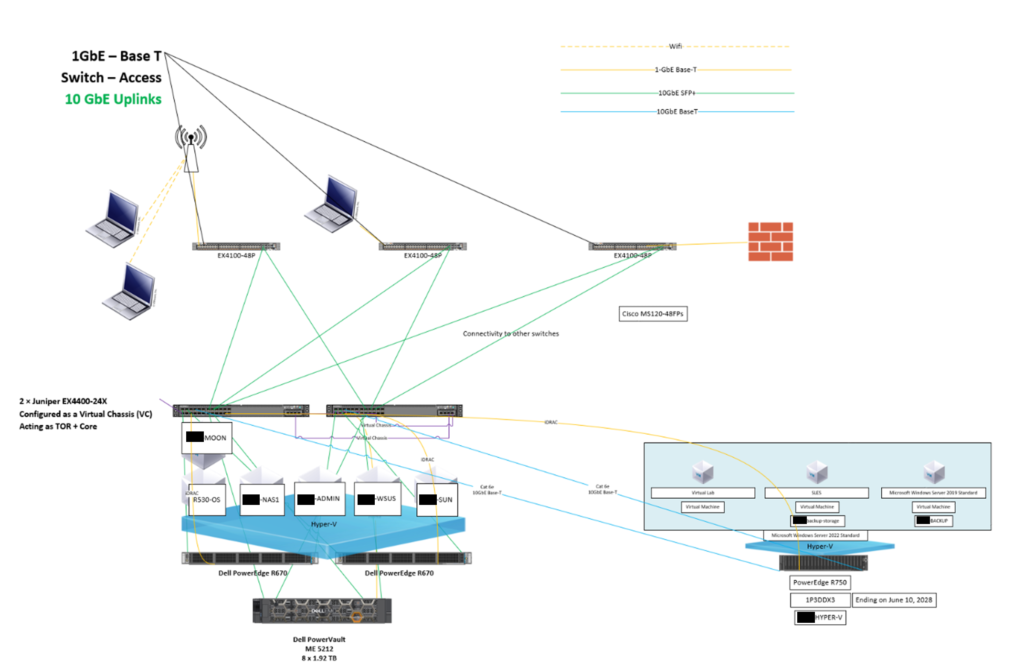
The deployment included:
- Deployment of a two-node Hyper-V failover cluster
- Dell PowerVault ME5212 shared enterprise storage implementation
- Redundant Juniper EX4400-24X 10GbE core switch deployment
- VLAN and network segmentation for compute, storage, backup, management, and out-of-band traffic
- Integration of existing access switches into the new core network
- iSCSI connectivity and multipath I/O configuration
- Cluster Shared Volume configuration
- Windows Admin Center deployment for centralized administration
- Dell OpenManage integration for hardware monitoring and lifecycle visibility
- Veeam Backup & Replication integration with the new Hyper-V environment
- Physical-to-virtual workload migration using Veeam-based P2V conversion
- Backup validation and restore testing
- Legacy infrastructure decommissioning and operational handoff
The environment also leveraged repurposed 1GbE Base-T connections for out-of-band iDRAC management, providing independent hardware access outside the production network and improving operational control during troubleshooting and maintenance activities.
Data Networks executed workload migrations using a phased, low-risk methodology designed to minimize operational disruption while validating post-migration application availability, service performance, and data integrity.
Delivering a Scalable and Resilient Virtualization Platform
Following implementation, the agency gained a resilient Hyper-V failover cluster environment capable of supporting current operational requirements while providing a scalable foundation for future infrastructure modernization.
The new redundant 10GbE core architecture eliminated existing throughput bottlenecks and improved consistency for end-user traffic, storage communication, virtualization workloads, and backup operations. Consolidation of physical workloads into the Hyper-V failover cluster also simplified administration, reduced hardware sprawl, improved recoverability, and eliminated multiple infrastructure single points of failure.
By combining highly available virtualization, enterprise shared storage, resilient networking, and centralized lifecycle management, Data Networks delivered a modern infrastructure platform aligned with the agency’s operational priorities, long-term sustainability goals, and future growth requirements.
Tags: SLG, local, data center, datacenter