
Recent Projects
Recent Project
Network Security Assessment & Remediation Roadmap for Maryland University
Wired Network Assessment and Infrastructure Modernization Strategy for Audit Readiness
Identifying Critical Security Risks Across a Complex Campus Environment
This Maryland-based university sought to strengthen its cybersecurity posture and modernize its network infrastructure following a comprehensive security assessment that revealed significant vulnerabilities across its environment. Previous assessments conducted by Data Networks identified dozens of network security findings, including outdated hardware, weak encryption methods, clear-text management protocols, incomplete network documentation, and gaps in disaster recovery readiness. Additional concerns were raised through audit findings and evolving regulatory requirements tied to NIST IA-2 and other higher education security frameworks.
To help the university achieve audit readiness and improve long-term operational resilience, Data Networks was engaged to perform a comprehensive network security assessment across the institution’s wired network infrastructure. The assessment encompassed 28 campus buildings, 69 network closets, approximately 98 network devices, Palo Alto firewalls, F5 load balancers, and related network services.

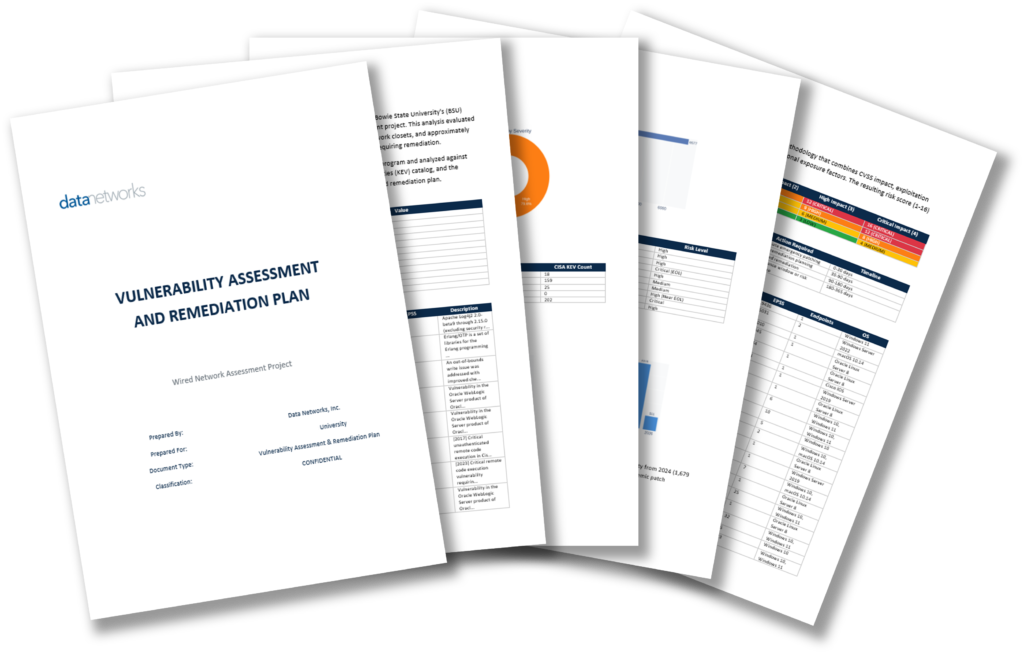
As part of the engagement, Data Networks analyzed vulnerability scan results covering more than 231,000 vulnerability instances and over 9,000 unique CVEs across 1,400+ endpoints. The assessment identified 202 CISA Known Exploited Vulnerabilities (KEVs), multiple critical vulnerabilities affecting network infrastructure, and significant risks associated with aging Cisco Catalyst hardware, end-of-life operating systems, and insufficient segmentation controls.
Delivering a Comprehensive Network Security Assessment and Modernization Strategy
Data Networks conducted extensive discovery activities, including inventory validation, configuration reviews, vulnerability analysis, firewall assessments, fiber infrastructure documentation, closet inspections, server room evaluations, and reviews of DNS, IDS/IPS, and remote access security controls.
The resulting network security assessment provided a detailed analysis of the university’s current-state environment and mapped identified risks against NIST Cybersecurity Framework (CSF) 2.0 requirements and audit compliance objectives. Data Networks developed a risk-prioritized remediation roadmap that categorized vulnerabilities by severity and established phased implementation timelines to accelerate risk reduction.
In addition to identifying immediate remediation priorities, Data Networks designed a strategic modernization framework focused on Zero Trust principles. Recommendations included micro-segmentation, enhanced VLAN architecture, role-based access controls, MAC and port filtering, DMZ restructuring, encrypted management traffic, improved vulnerability management processes, and stronger identity-driven security controls.
The assessment also evaluated physical infrastructure components such as fiber connectivity, network closet organization, power redundancy, and disaster recovery readiness. Data Networks delivered recommendations for hardware lifecycle management, including replacement strategies for aging network infrastructure and plans to improve resiliency across critical campus systems.
Creating a Roadmap for Security, Compliance, and Long-Term Operational Excellence
The completed network security assessment provided the university with a comprehensive blueprint for achieving compliance, reducing cybersecurity risk, and modernizing campus infrastructure. Data Networks delivered updated network diagrams, security documentation, remediation roadmaps, risk-prioritization matrices, and implementation planning guides to support self-management and future decision-making.
The network security assessment also provided a clear path toward compliance with NIST IA-2 requirements, improved readiness for future audits, enhanced visibility into campus-wide vulnerabilities, and a structured framework for proactive vulnerability management. Data Networks also established recommendations for ongoing monitoring, continuous vulnerability scanning, patch management automation, lifecycle replacement planning, and security operations improvements.
By combining technical analysis, infrastructure planning, and cybersecurity strategy, Data Networks enabled the university to transition from a reactive approach to security toward a proactive, risk-based model that supports institutional resilience, operational continuity, and long-term technology modernization.
Tags: Hi-Ed, Hi Ed, networking