
Recent Projects
Recent Project
Azure Stack HCI Migration for VMware Cost Optimization & Site Resiliency
Hypervisor Modernization and Cross-Site Replication Deployment for Hybrid Data Center Operations
Reducing VMware Costs While Preserving Site Resiliency
This Maryland-based university’s central IT organization was facing rising operational costs due to significant changes in VMware’s licensing model. While the organization’s VMware vSAN Stretched Cluster environment continued to provide the functionality and resiliency required for critical operations, the escalating licensing costs no longer aligned with budgetary objectives. The organization needed a strategy to reduce expenses without sacrificing performance, availability, or disaster recovery capabilities.
At the same time, maintaining site resiliency remained a critical requirement. The existing infrastructure was designed around a stretched-cluster architecture spanning two locations, ensuring workloads could continue operating in the event of a site outage. Any modernization effort needed to preserve business continuity while reducing dependency on VMware technologies.
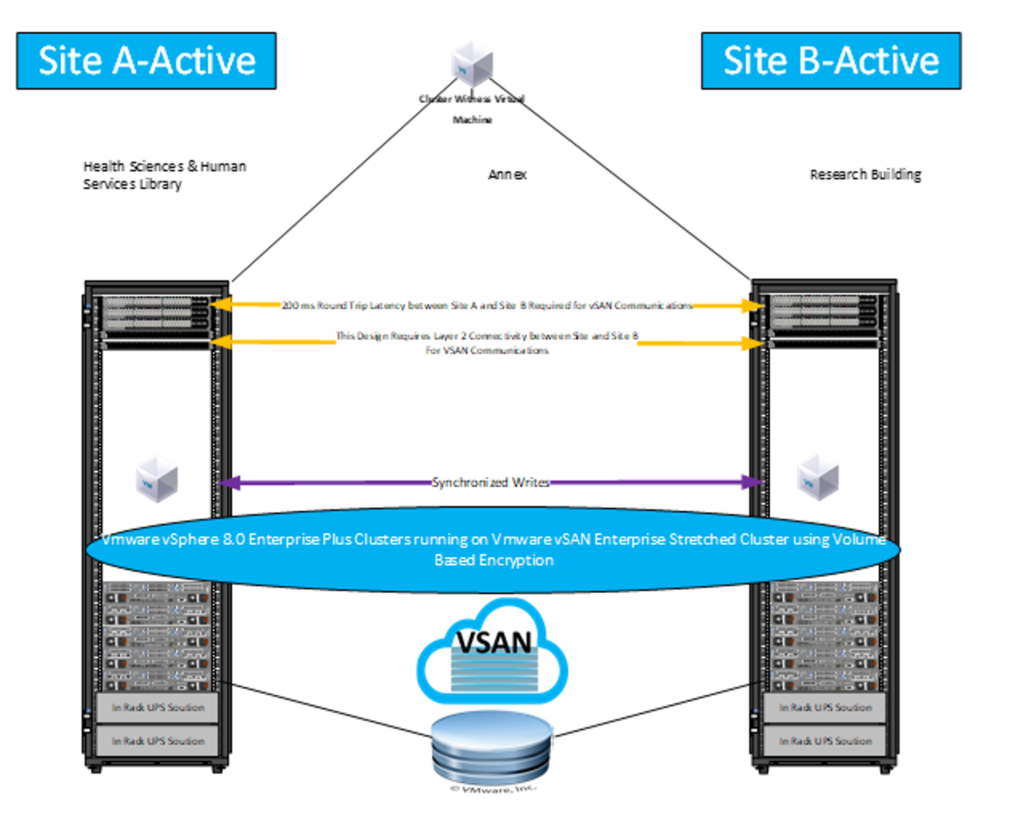
To address these challenges, the organization partnered with Data Networks to execute an Azure Stack HCI migration project that would reduce VMware licensing costs, modernize virtualization infrastructure, and maintain cross-site resiliency through replication and recovery capabilities.
Deploying Azure Stack HCI Across Two Data Center Sites
Data Networks developed a phased migration strategy centered on repurposing existing VMware vSAN Ready Nodes into two new Azure Stack HCI clusters. The project began with a detailed assessment of the existing environment and identification of fifty virtual machines selected for migration from the stretched-cluster infrastructure.
As part of the Azure Stack HCI migration, Data Networks evacuated workloads from four VMware vSAN Ready Nodes— two located at each site— and removed those nodes from the existing VMware environment. The nodes were then reconfigured and redeployed as two separate Azure Stack HCI clusters, with a two-node cluster operating at Site A and a two-node cluster operating at Site B.
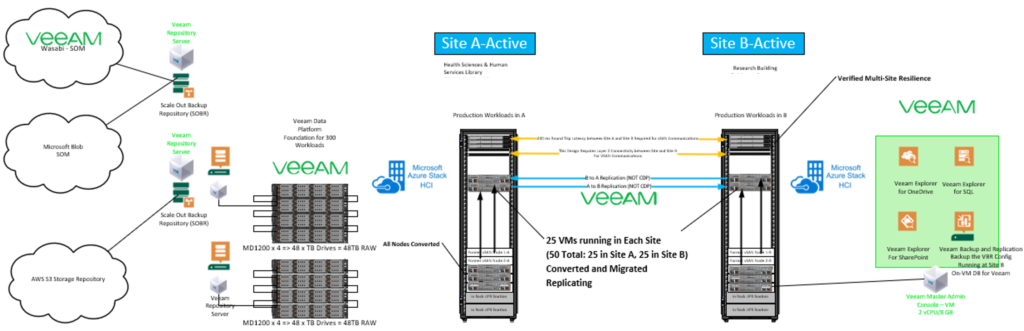
Each cluster was configured with Windows Admin Center, Storage Spaces Direct volumes, BitLocker disk encryption, data deduplication, and data compression capabilities. These technologies provided a secure and efficient hyperconverged platform capable of supporting production workloads while maximizing storage utilization and operational efficiency.
Following infrastructure deployment, Data Networks executed a structured migration process that included pilot migrations, validation testing, and full-scale workload conversion. 50 VMware virtual machines were converted to Hyper-V virtual machines and migrated to the new Azure Stack HCI environment, with workloads strategically distributed between Site A and Site B to support operational requirements.
Strengthening Disaster Recovery with Veeam Replication
Maintaining site resiliency was a core objective throughout the project. To support ongoing business continuity requirements, Data Networks reconfigured the organization’s Veeam environment to provide bidirectional workload replication between the two Azure Stack HCI clusters.
The new architecture enables workloads hosted at Site A to replicate to Site B while simultaneously supporting replication of Site B workloads to Site A. Comprehensive testing and validation were performed to verify replication functionality, failover readiness, and recovery capabilities across both locations.
Beyond migration activities, Data Networks optimized the new environment for performance, reliability, and long-term manageability. Detailed documentation was created, knowledge transfer sessions were conducted with the IT team, and performance benchmarks were validated to ensure the new infrastructure met operational expectations.
The completed Azure Stack HCI migration delivered a modern, cost-effective virtualization platform that significantly reduced VMware licensing dependency while preserving site resiliency and disaster recovery capabilities. By leveraging existing hardware investments, implementing Hyper-V-based infrastructure, and enabling cross-site replication through Veeam, the organization gained a scalable foundation for future growth while achieving meaningful cost savings and operational efficiencies.
Tags: Hi-Ed, Hi Ed, datacenter