
Recent Projects
Recent Project
Hyper-V & Storage Spaces Direct (S2D) Migration
Eliminating VMware Licensing Costs with a Phased Hyper-V Migration Strategy for a Large Maryland University
The Challenge: Escalating VMware Costs and a Complex Stretched Cluster Environment
This Maryland-based university’s IT center faced mounting infrastructure and operational challenges driven by VMware’s evolving licensing model and the increasing cost of maintaining a VMware-centric data center architecture.
The existing environment relied heavily on VMware technologies including vSphere and vSAN Stretched Clusters, creating a tightly coupled infrastructure that limited flexibility and modernization opportunities. Licensing costs had increased significantly due to VMware’s shift toward per-core and per-GB pricing, while advanced capabilities such as micro-segmentation and disaster recovery orchestration no longer justified the growing operational expense.
The university IT center also depended on a complex stretched-cluster architecture spanning two production sites, requiring a carefully orchestrated re-architecture to decouple workloads from VMware technologies without disrupting mission-critical operations. Existing infrastructure investments— including distributed switches and legacy storage configurations— further complicated the migration path.
To address these challenges, the university IT center partnered with Data Networks to execute a phased Hyper-V and Storage Spaces Direct (S2D) migration initiative designed to eliminate VMware licensing costs, modernize the environment, and establish a scalable Microsoft-based virtualization platform.
The Solution: Phased Hyper-V and Storage Spaces Direct Migration
Data Networks delivered a structured Hyper-V and S2D migration strategy built upon a previously completed Phase 1 deployment that established two-node Microsoft Hyper-V and S2D clusters at both Site A and Site B.
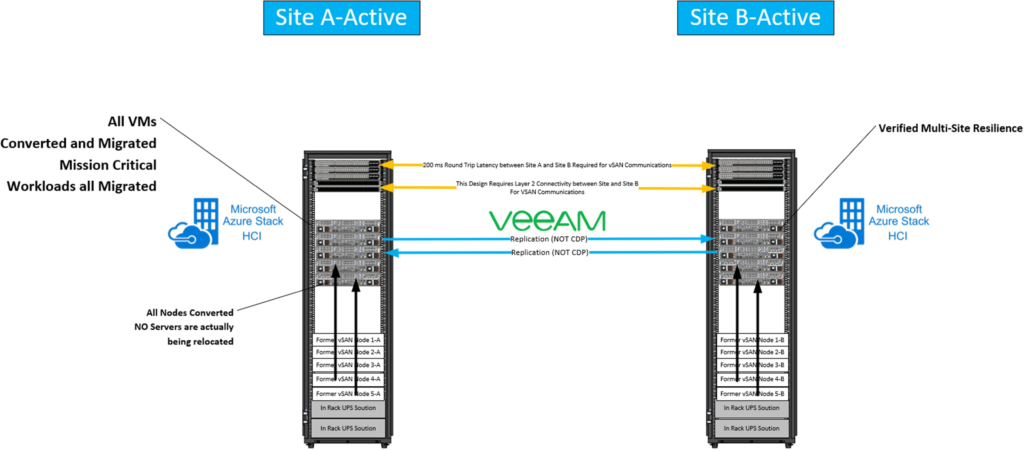
The next phase focused on safely expanding the Hyper-V environment while gradually decommissioning the remaining VMware vSAN stretched cluster infrastructure.
The engagement began with comprehensive pre-expansion validation activities, including cluster health analysis, storage reviews, network and SMB validation, RDMA checks, latency testing, and remediation of any issues that could impact cluster expansion activities. Data Networks also delivered validation summaries for each site to confirm readiness before migration activities proceeded.
Working alongside the university’s IT administration team, Data Networks provided PowerShell automation scripts for Hyper-V cluster onboarding and SCVMM registration. Data Networks engineers performed the first node join while university IT administrators observed, then guided subsequent joins to support operational ownership and long-term sustainability.
The project included staged deployment of Veeam on-host proxies across newly converted Hyper-V nodes to ensure backup visibility, replication continuity, and disaster recovery readiness throughout the migration process.
As part of the phased conversion, the university IT center migrated the remaining 238 active VMware virtual machines from the existing vSAN stretched cluster into the Hyper-V environment prior to cluster decommissioning. The overall infrastructure consisted of 276 total VMs, with 96 TB of active workload storage and 2.5 TB of peak memory utilization.
Once workload migration and validation were completed, the university IT center executed a controlled break of the VMware vSAN stretched cluster, including witness decommissioning and validation of the split-cluster state. Additional repurposed vSAN Ready Nodes were then converted into Windows Server 2022 Hyper-V hosts with Storage Spaces Direct to expand both Site A and Site B production clusters.
Data Networks also supported final replication validation, disaster recovery testing, cluster health assessments, failover simulations, Veeam integration checks, SCVMM validation, Windows Admin Center integration, and operational monitoring readiness.
Ongoing Value: A Scalable Microsoft-Based Virtualization Platform
This Hyper-V and S2D migration project enabled the university IT center to fully transition away from VMware licensing while establishing a modern Microsoft-based virtualization environment optimized for scalability, resiliency, and operational efficiency.
The new architecture leverages Microsoft Windows Server 2022, Hyper-V, Storage Spaces Direct, SCVMM, Windows Admin Center, and Veeam to deliver a streamlined and highly available virtualization platform spanning multiple production sites.
By repurposing existing vSAN Ready Nodes into Hyper-V infrastructure, the IT center extended the value of prior hardware investments while significantly reducing recurring licensing costs and simplifying infrastructure management.
The phased migration approach also minimized operational risk, preserved production continuity, and enabled gradual knowledge transfer to the university’s IT administration team. Through guided onboarding, automation scripts, documentation delivery, and collaborative deployment activities, Data Networks helped empower the IT center to assume long-term operational ownership of the new environment.
Following project completion, the university IT center now benefits from improved scalability, enhanced disaster recovery readiness, simplified cluster management, and a future-ready virtualization platform designed to support ongoing growth and modernization initiatives.
Tags: Hi-Ed, higher education, datacenter