
Recent Projects
Recent Project
Juniper Firewall Upgrade & Disaster Recovery Optimization
Juniper SRX High Availability Modernization for Campus Network Resiliency
Addressing Network Stability and Business Continuity Challenges
This Pennsylvania-based community college issued a Request for Proposals (RFP) seeking a qualified partner to troubleshoot, upgrade, optimize, and enhance the disaster recovery capabilities of its Juniper SRX 4100 firewall environment. Data Networks was selected as the awarded contractor based on its comprehensive technical approach, deep Juniper Networks expertise, and proven experience supporting complex higher education network infrastructures. The project focused on improving network reliability, resolving persistent Layer 2 issues, modernizing the firewall operating system, and strengthening disaster recovery readiness while minimizing operational disruption.
At the center of the college’s network infrastructure were two Juniper SRX 4100 firewalls operating in a high-availability (HA) configuration that supported campus connectivity, satellite locations, internet services, and business continuity initiatives. The college was experiencing Layer 2 port errors that impacted network stability and sought to upgrade its Junos operating system after previous upgrade attempts had resulted in significant service interruptions. Additionally, the college wanted to enhance its disaster recovery architecture by relocating one firewall to a geographically separate disaster recovery site while maintaining resiliency and failover capabilities.
Executing a Strategic Juniper Firewall Upgrade
Data Networks began the engagement with a comprehensive assessment of the Juniper SRX 4100 environment to identify the root causes of Layer 2 network errors. Engineers reviewed VLAN configurations, interface settings, hardware diagnostics, traffic patterns, and system logs to isolate performance issues and implement corrective actions that improved overall network stability.

Once the environment was stabilized, Data Networks executed a carefully planned Juniper firewall upgrade. The team performed extensive compatibility reviews, validated configurations against the target Junos release, and developed detailed rollback procedures to mitigate risk. Leveraging the existing HA architecture, upgrades were completed in a staged manner, beginning with the standby device to maintain service availability throughout the process.
The project also included external configuration backups, pre-upgrade validation testing, and coordination with Juniper Technical Assistance Center (JTAC) resources to help ensure a smooth and successful operating system transition.
Strengthening Disaster Recovery and Long-Term Performance
A key component of the project focused on enhancing the college’s disaster recovery capabilities. Data Networks redesigned the high-availability architecture to support the relocation of one SRX 4100 appliance to a dedicated disaster recovery site connected through existing fiber infrastructure. The team adjusted control and fabric links, routing configurations, redundancy settings, and failover mechanisms to support reliable operation across geographically separated locations.
Following the relocation, extensive testing was performed to validate connectivity, synchronization, failover functionality, and overall performance. Particular attention was given to preventing split-brain scenarios and ensuring that disaster recovery objectives could be achieved without compromising day-to-day operations.
To conclude the engagement, Data Networks conducted a comprehensive configuration review covering security policies, NAT rules, routing protocols, interface settings, and disaster recovery configurations. Recommendations were provided to improve security, streamline management, optimize performance, and align the environment with industry best practices.
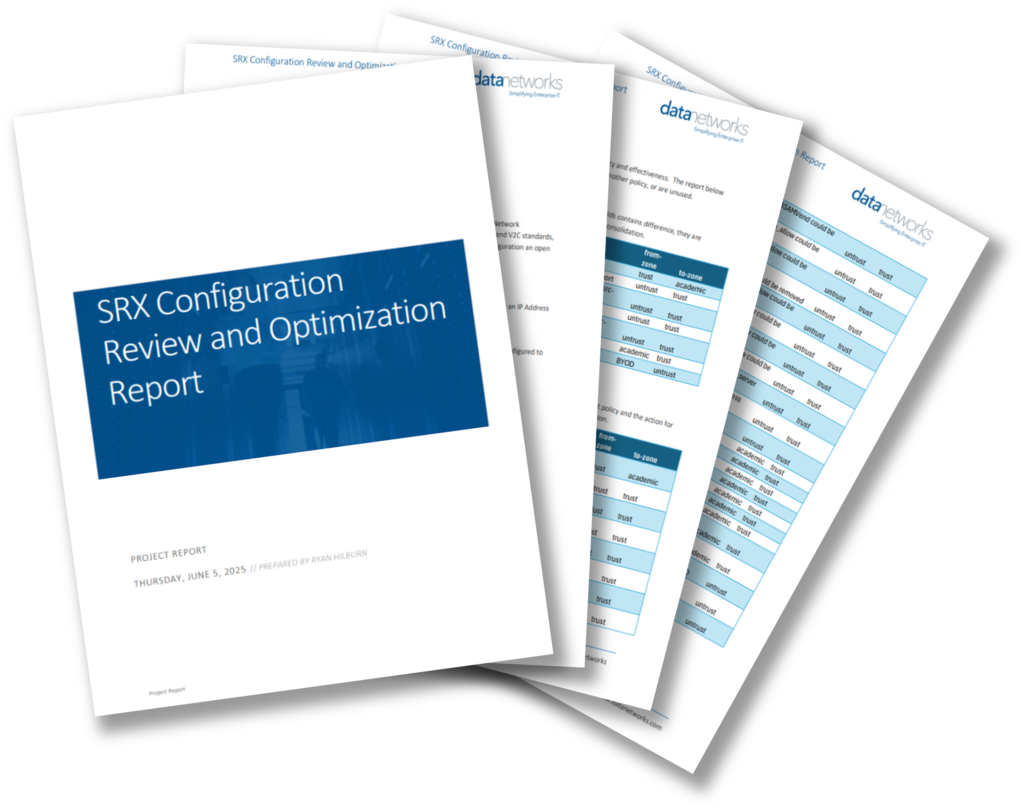
The project concluded with detailed configuration documentation, updated network diagrams, change logs, maintenance recommendations, and knowledge transfer sessions for the college’s IT staff. As a result, the community college gained a more stable, secure, and resilient network environment capable of supporting both current operational needs and future disaster recovery requirements.
Tags: Hi-Ed, Hi Ed, networking