
Recent Projects
Recent Project
Microsoft Identity Manager Sandbox Deployment for Identity Management Testing
Secure Identity Synchronization Validation and Knowledge Transfer Environment
Creating a Safe Environment for Identity Management Innovation
This Maryland-based university relied heavily on Microsoft Identity Manager (MIM) to synchronize identities, attributes, and passwords across multiple Active Directory domains. As identity management requirements evolved, the institution faced increasing challenges testing changes safely without impacting production operations. Existing processes lacked a dedicated environment for validating synchronization rules, troubleshooting attribute flows, and evaluating configuration changes before deployment.
Without a sandbox environment, even minor configuration adjustments carried the risk of disrupting identity synchronization, introducing data inconsistencies, or affecting critical user access services. Additionally, the institution sought to reduce dependence on external vendors by improving internal knowledge of Microsoft Identity Manager administration and troubleshooting.
To address these challenges, the university partnered with Data Networks to deploy a dedicated Microsoft Identity Manager sandbox environment that would replicate the production infrastructure while providing a secure platform for testing, validation, training, and operational readiness.
Building a Dedicated Microsoft Identity Manager Sandbox
Data Networks began the engagement with a comprehensive review of the existing Microsoft Identity Manager environment, infrastructure dependencies, domain relationships, and synchronization requirements. The team validated server readiness, virtual infrastructure resources, network connectivity, firewall configurations, licensing requirements, and domain controller availability to ensure the environment was prepared for deployment.
As part of the Microsoft Identity Manager sandbox implementation, Data Networks deployed and configured a complete replica of the production MIM architecture. This included installation and configuration of the MIM Synchronization Service, SQL Server database infrastructure, and MIM Portal services running on SharePoint.
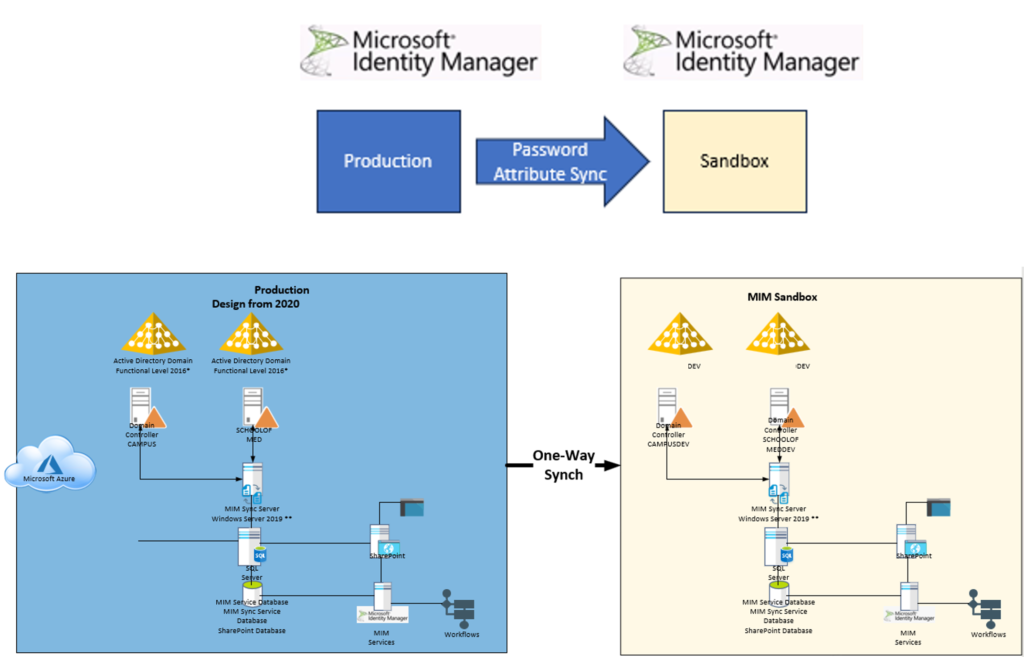
Prior to deployment, Data Networks worked closely with the university’s IT team to back up and document existing configurations while performing cleanup activities within the production MIM database. This preparation helped ensure a consistent and reliable foundation for the new sandbox environment.
The resulting sandbox environment provided a dedicated testing platform capable of supporting identity synchronization validation across multiple development domains while remaining isolated from production operations.
Validating Attribute Flows and Empowering Internal Teams
A key objective of the project was enabling safe testing of attribute and password synchronization workflows across multiple Active Directory environments. Data Networks configured synchronization rules to support attribute flow validation between development domains while maintaining strict controls around existing attributes and synchronization policies.
The Microsoft Identity Manager sandbox was designed to support testing between university’s three domain environments. Password synchronization capabilities were also implemented and validated to ensure the institution could safely evaluate synchronization behavior prior to making production changes.
Data Networks conducted extensive testing to validate attribute synchronization, password synchronization, connectivity, DNS resolution, and end-to-end workflow functionality. Real-world scenarios were simulated to confirm that synchronization processes operated as expected and to identify any issues before the environment was handed over.
To support long-term operational success, Data Networks incorporated structured knowledge transfer throughout the engagement. Shadow sessions allowed university staff to participate directly in connector deployment activities, while recorded walkthroughs provided reusable training resources for future administrators. Detailed documentation covering synchronization rules, configurations, architecture, and testing procedures was delivered to support ongoing maintenance and troubleshooting.
The completed Microsoft Identity Manager sandbox project provided the university with a secure, fully functional environment for testing and validating identity management changes before production deployment. The solution reduced operational risk, improved change management processes, strengthened identity governance capabilities, and empowered internal IT staff to take a more active role in managing and maintaining the institution’s identity infrastructure.
Tags: Hi-Ed, Hi Ed, data center, datacenter