
Recent Projects
Recent Project
VMware to Hyper-V Conversion for Long-Term Data Center Cost Savings
Reducing Virtualization Costs Through a Strategic Hyper-V Infrastructure Migration
Overcoming Rising VMware Costs and Aging Infrastructure
This Virginia public school district was facing growing challenges with its existing virtualization environment. The district’s VxRail infrastructure was approaching the end of its supported lifecycle, limiting future upgrade options and increasing operational risk. At the same time, VMware’s transition to the VMware Cloud Foundation (VCF) licensing model significantly increased virtualization costs, creating budget concerns for long-term infrastructure planning.
The district needed a modern virtualization platform that could deliver the performance, scalability, and resiliency required to support critical workloads while dramatically reducing recurring software licensing expenses. Additionally, the solution needed to leverage existing network investments and avoid unnecessary infrastructure replacement costs.
To address these objectives, the district partnered with Data Networks to execute a comprehensive VMware to Hyper-V conversion project that modernized the data center, migrated workloads to Microsoft Hyper-V, and established a cost-effective foundation for future growth.
Building a Modern Hyper-V Infrastructure
Data Networks began the engagement with a detailed assessment of the existing virtualization environment, including hardware inventories, network connectivity, storage architecture, and workload dependencies. A phased migration plan was developed to minimize disruption and ensure successful workload conversion.
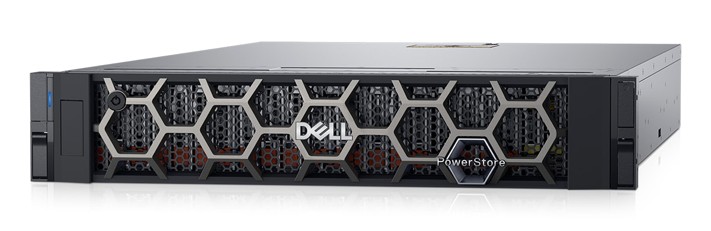
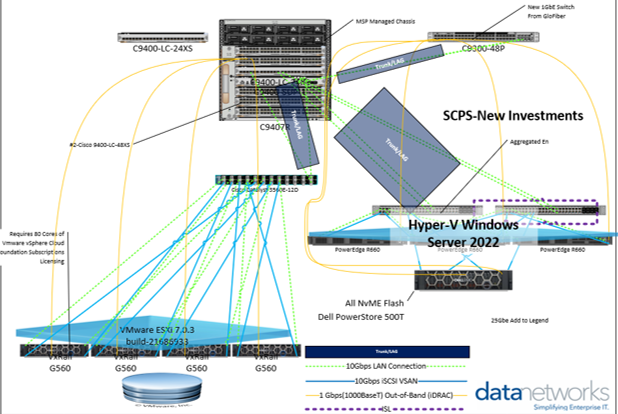
The new infrastructure consisted of three Dell PowerEdge R660 servers and a Dell PowerStore 500T storage array designed to provide enterprise-class performance and scalability.

To support high-speed connectivity while maintaining compatibility with the existing network core, Data Networks deployed two Juniper QFX5120 switches configured as a Virtual Chassis environment. This design provided redundancy, simplified management, and seamless integration with the district’s Cisco 9407R switching infrastructure.

As part of the VMware to Hyper-V conversion, Data Networks deployed a Microsoft Hyper-V cluster and configured Windows Admin Center as the centralized management platform. The team also integrated Dell OpenManage capabilities into Windows Admin Center, providing administrators with enhanced visibility into server health, performance, and lifecycle management.
The Dell PowerStore 500T SAN was configured as the shared storage platform for the cluster, delivering reliable and high-performance storage resources to support virtual machine operations and future expansion requirements.
Migrating Workloads and Delivering Long-Term Savings
After validating infrastructure readiness and cluster performance, Data Networks initiated a phased VMware to Hyper-V conversion of 75 virtual machines. The migration process was carefully planned to prioritize workload continuity and minimize operational disruption. Initial migrations focused on lower-risk systems to validate conversion procedures before transitioning business-critical applications.
Each virtual machine was converted from VMware to Hyper-V, migrated to the new cluster, and subjected to extensive testing to verify functionality, performance, and connectivity. Data Networks monitored workloads throughout the migration process and optimized the environment to ensure stable operations following conversion.
Once all workloads were successfully migrated, comprehensive post-migration validation confirmed that applications, services, and data were operating as expected on the new Microsoft platform. The result was a fully functional Hyper-V environment capable of supporting the district’s current and future requirements.
The completed VMware to Hyper-V conversion project delivered substantial value by eliminating VMware Cloud Foundation licensing costs while modernizing the district’s virtualization infrastructure. The new environment provides centralized management, improved scalability, enterprise storage performance, and long-term operational savings without sacrificing functionality or reliability.
The project concluded with comprehensive documentation, knowledge transfer sessions, and operational handoff to the district’s IT team, ensuring they were fully prepared to manage and maintain the new Hyper-V environment moving forward.
Tags: K-12, K12, education, datacenter