
Recent Projects
Recent Project
VMware to Hyper-V Migration for Public School District
Enterprise Virtualization Platform Transformation with Azure Stack HCI
Replacing Aging VMware Infrastructure with a Cost-Effective Alternative
This Maryland public school district faced a significant infrastructure challenge as its VMware-based virtualization environment approached end of support. The district’s production environment relied on a VxRail VMware vSAN hyperconverged infrastructure platform, while VMware vSphere ROBO hosts supported critical workloads at school locations throughout the district. With increasing licensing costs, aging infrastructure, and a need to maintain high levels of performance and availability, the district sought a more cost-effective and sustainable virtualization strategy.
The organization needed a solution that could preserve the benefits of hyperconverged infrastructure while reducing operational complexity and licensing expenses. In addition, the district required a centralized management platform capable of providing visibility and control across production, disaster recovery, and school-based environments. To achieve these objectives, the district partnered with Data Networks to execute a large-scale VMware to Hyper-V migration and modernize its virtualization infrastructure.
Executing a Comprehensive VMware to Hyper-V Migration
Data Networks designed and deployed a new Azure Stack HCI environment built on five Dell AX-750 server nodes connected through high-speed 25Gbps networking infrastructure. The deployment included Dell S5248F switches, Storage Spaces Direct (S2D), Hyper-V, Windows Admin Center, and Azure Stack HCI software components, creating a highly available and scalable hyperconverged platform.
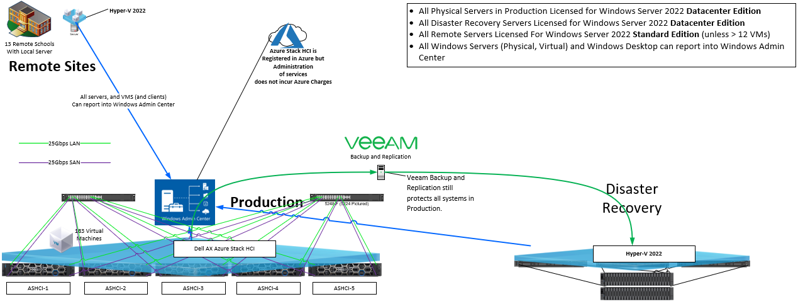
Following the physical deployment and configuration of the new infrastructure, Data Networks performed the core VMware to Hyper-V migration, converting and migrating 183 production virtual machines from the district’s existing VxRail environment. Using specialized migration and conversion tools, workloads were successfully transformed from VMware-based virtual machines to Hyper-V virtual machines and restored onto the new Azure Stack HCI cluster.
To minimize disruption to district operations, mission-critical applications and services were migrated during off-hours whenever possible. The new platform was designed to deliver enterprise-class performance, resiliency, and scalability while significantly reducing dependence on VMware licensing.
In parallel with the production migration, Data Networks converted the district’s disaster recovery infrastructure, including three Dell R650 hosts and a Dell ME5024 SAN. 20 disaster recovery workloads were migrated to a new Hyper-V-based disaster recovery environment, ensuring continued business continuity and recovery readiness.
Unifying Management Across Data Center and School Environments
The project extended beyond the district’s primary data centers. Data Networks also migrated 13 standalone VMware hosts located at major schools throughout the district. 70 school-based virtual machines were converted and migrated to Hyper-V, creating consistency across the entire virtualization environment.
To simplify administration, all Hyper-V hosts, virtual machines, and Azure Stack HCI resources were integrated into Microsoft Windows Admin Center. This centralized management platform replaced VMware vCenter as the primary control plane, providing administrators with unified visibility into compute, storage, networking, monitoring, and reporting functions.
The completed VMware to Hyper-V migration delivered a modernized virtualization platform that reduced licensing costs, improved administrative efficiency, and preserved the high availability and performance expected from a hyperconverged infrastructure solution. By standardizing on Microsoft technologies and consolidating management under a single platform, the district established a scalable foundation for future growth while improving operational efficiency across its entire IT environment.
Data Networks also provided detailed documentation, administrator training, and knowledge transfer services to ensure the district’s IT team could confidently manage and support the new environment long after project completion.
Tags: K12, education, data center, datacenter