
Recent Projects
Recent
Archives
Recent Project
Server Replacement & Workload Consolidation for Higher Education Infrastructure Modernization
Hyper-V Consolidation and Legacy Server Modernization with Dell PowerEdge and Windows Server 2025
Modernizing Legacy Infrastructure Through Server Replacement and Workload Consolidation
This Maryland college initiated a strategic infrastructure modernization effort to replace aging physical servers, reduce operational complexity, and align its data center environment with an ongoing high-speed network modernization initiative. The existing infrastructure included ten standalone physical servers, several operating on unsupported or aging Windows Server platforms that increased security exposure, maintenance overhead, and operational risk.
To modernize the environment, Data Networks implemented a server replacement and workload consolidation project centered on Microsoft Hyper-V 2025 and Dell PowerEdge infrastructure. The engagement consolidated legacy physical workloads into a modern virtualization platform designed to improve resiliency, simplify management, optimize resource utilization, and establish a scalable foundation for future institutional growth.
The project also strengthened backup resiliency by expanding the college’s existing single-node Hyper-V backup environment into a redundant two-node cluster supporting the Veeam backup platform.
Addressing Aging Hardware and Operational Inefficiencies
The college’s legacy infrastructure environment consisted of standalone physical systems with inconsistent resource utilization and growing lifecycle concerns. Several servers remained in production on Windows Server 2008 and Windows Server 2012, creating increased supportability and security challenges as those platforms approached or exceeded end-of-support milestones.
Because workloads were distributed across multiple standalone systems, the environment also suffered from fragmented management practices, underutilized compute and storage resources, and unnecessary power, cooling, and backup overhead. Operational visibility and lifecycle management were further complicated by inconsistent hardware standards across servers.
At the same time, the college was upgrading its data center network architecture from a 10GbE core to a 100GbE core with 25GbE data center access connectivity. The modernization effort needed to eliminate legacy 1GbE bottlenecks and fully leverage the improved network throughput available within the upgraded infrastructure.
The college also sought to reduce the risks associated with standalone physical systems by improving virtualization-based resiliency and introducing greater workload mobility and recovery flexibility.
Deploying a Modern Hyper-V Virtualization Platform
Data Networks deployed five Dell PowerEdge R570 servers for the production Hyper-V environment and one Dell PowerEdge R670 server to expand the college’s backup Hyper-V cluster. The new infrastructure was configured with Windows Server 2025 Datacenter, Hyper-V, standardized BIOS and firmware baselines, Dell BOSS controllers, and 10/25GbE networking aligned with the college’s upgraded data center architecture.
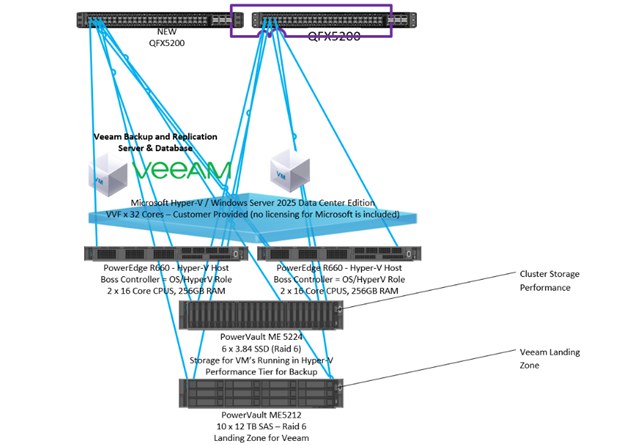
The project included:
- Deployment of Windows Server 2025 Hyper-V hosts
- Server replacement and consolidation of ten physical systems
- Physical-to-virtual workload migration
- 10/25GbE SFP28 networking configuration
- VLAN segmentation for management, production, Live Migration, and backup traffic
- Switch Embedded Teaming (SET) configuration where applicable
- Expansion of the Veeam environment into a two-node Hyper-V backup cluster
- Windows Admin Center implementation for centralized administration
- Dell OpenManage Integration for lifecycle visibility and hardware monitoring
- Azure Arc onboarding for hybrid management and governance
- Post-migration testing and validation of performance, service availability, and data integrity
Data Networks coordinated migration activities closely with college IT staff to minimize service disruption during workload cutovers. All in-scope workloads were right-sized and migrated into the new Hyper-V platform to improve operational efficiency and resource utilization while maintaining performance expectations. Legacy physical servers were then properly decommissioned and retired from service.
Delivering a Scalable and Resilient Infrastructure Foundation
Upon completion, the college gained a modernized Hyper-V infrastructure platform that improved resiliency, simplified management, and reduced the operational burden associated with maintaining aging standalone hardware.
The server replacement and workload consolidation strategy enabled the college to significantly reduce hardware footprint while improving scalability and centralized operational visibility. Expansion of the backup Hyper-V environment also eliminated the single-host dependency supporting the Veeam platform, improving redundancy and backup resiliency.
By aligning infrastructure modernization with the college’s upgraded 25GbE and 100GbE network architecture, Data Networks helped the college establish a future-ready virtualization platform capable of supporting evolving institutional and operational requirements.
Tags: Hi-Ed