
Recent Projects
Recent
Archives
Recent Project
Microsoft Configuration Manager Deployment for University Device Management
Replacing Legacy Endpoint Management with a Scalable Microsoft-Based Platform
Modernizing Device Management Across a University Department
This school of social work within a large university faced growing challenges with its existing endpoint management platform. The department relied on KACE systems for software deployment, patching, and device administration, but the solution had become increasingly expensive to maintain and no longer aligned with the university’s broader IT strategy. At the same time, the department needed greater control over approximately 750 Windows and macOS devices while ensuring its IT administrators could manage their own environment without impacting systems owned by other university departments.
To support long-term operational efficiency and standardization, the department sought to align its device management strategy with the university’s central IT organization. Rather than maintaining a separate management platform, the goal was to leverage capabilities already available through existing Microsoft 365 A3 licensing and expand the university’s established Microsoft Configuration Manager environment to support departmental needs.
The department partnered with Data Networks to implement a comprehensive Microsoft Configuration Manager deployment that would replace KACE, improve endpoint management capabilities, and align the department’s technology operations with the university’s enterprise management framework.
Microsoft Configuration Manager Deployment Replaces Legacy KACE Infrastructure
As part of the project, Data Networks expanded the university’s existing Microsoft Configuration Manager environment to include the department’s Active Directory child domain. This Microsoft Configuration Manager deployment enabled the department to leverage the same enterprise-grade management platform used by the university’s central IT organization while maintaining administrative independence over its own devices.
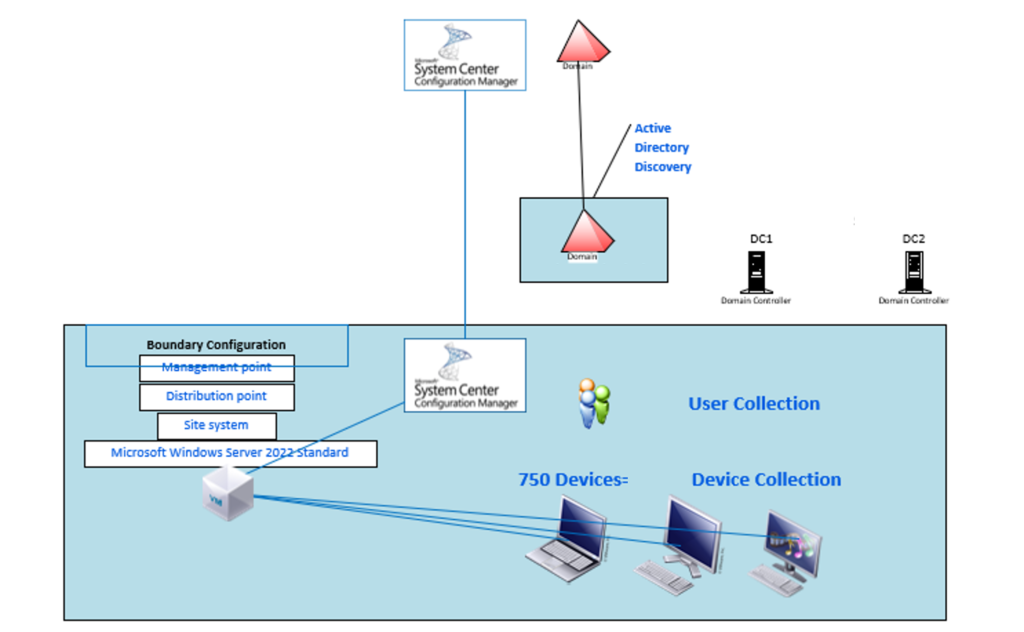
The engagement began with validation of remote access, domain connectivity, and required administrative permissions. Data Networks then configured boundary groups to support the department’s network infrastructure and implemented role-based administration policies that allowed departmental IT staff to manage their own devices without gaining access to systems owned by other university departments.
To support software distribution and reporting within the departmental environment, Data Networks deployed Azure-based virtual machines to host Distribution Point and Reporting Services Point roles. These resources improved application delivery performance, reduced network traffic across domains, and enabled department-specific reporting and device management capabilities.
The project also included verification of communication between the university’s parent domain and the department’s child domain, ensuring secure and reliable connectivity between Configuration Manager services and managed endpoints.
Streamlining Software Deployment and Device Lifecycle Management
A key component of the Microsoft Configuration Manager deployment involved migrating endpoint management responsibilities away from the legacy KACE platform. Data Networks deployed the Configuration Manager agent to departmental devices, created user and device collections, and instrumented more than 80 percent of the department’s managed endpoints.
The team also expanded PatchMyPC integration to support automated third-party application management and patching. Existing application deployment packages and deployment rules were leveraged to accelerate implementation while maintaining consistency with established university standards.
To minimize risk, Data Networks executed a phased rollout approach that included proof-of-concept, pilot, and production deployments. This methodology allowed the department to validate functionality, gather feedback, and address any issues before expanding the deployment across the broader user community. As part of the migration, the KACE management agent was removed from approximately 750 devices, fully transitioning endpoint management to the Microsoft platform.
Following implementation, Data Networks provided documentation, knowledge transfer sessions, and administrative guidance to ensure long-term success.
The completed Microsoft Configuration Manager deployment provided the university department with a scalable, cost-effective, and centrally aligned endpoint management solution. By replacing KACE with Microsoft Configuration Manager and PatchMyPC, the department gained improved visibility, streamlined patch management, enhanced administrative control, and a platform capable of supporting future growth while remaining aligned with the university’s enterprise IT strategy.
Tags: Hi-Ed, Hi Ed, higher education, data center, datacenter