
Recent Projects
Recent Project
Cybersecurity Assessment & Security Posture Improvement Roadmap
Comprehensive Vulnerability Assessment and Security Remediation Planning
Identifying Risks and Building a Stronger Security Foundation
This Maryland-based physician regulatory organization engaged Data Networks to conduct a comprehensive cybersecurity assessment following a recent security incident. The organization sought an independent review of its security posture, infrastructure configurations, endpoint security practices, and vulnerability management processes to better understand existing risks and develop a strategic roadmap for strengthening security controls.
The organization required a thorough evaluation of both internal and external attack surfaces, along with actionable recommendations that would improve cyber resilience, reduce operational risk, and support long-term security planning.
Assessing Infrastructure, Identity, and Endpoint Security
Data Networks performed a multi-layered security assessment that combined stakeholder interviews, configuration reviews, vulnerability scanning, cloud environment analysis, and endpoint security evaluation. The engagement included assessments of Active Directory, endpoint management practices, workstation and server security, Microsoft 365 configurations, vulnerability exposure, and overall administrative controls. The assessment methodology incorporated configuration analysis, vulnerability testing, physical and operational reviews, and executive-level reporting.
During the engagement, Data Networks utilized industry-leading assessment tools to evaluate the organization’s security posture and identify vulnerabilities that could negatively impact business operations. The review focused on areas such as identity management, privileged access controls, password policies, endpoint protection, patch management, hardware lifecycle planning, and overall vulnerability exposure.

The assessment revealed opportunities to strengthen identity security, improve vulnerability management processes, modernize endpoint protection practices, and reduce risks associated with aging hardware and unsupported software. Vulnerability testing also identified several critical and high-severity findings that required prioritization within the organization’s remediation strategy.
Developing a Prioritized Security Improvement Roadmap
Beyond identifying risks, Data Networks delivered a comprehensive remediation roadmap designed to help the organization improve its overall security maturity.
Key recommendations included:
- Reviewing privileged account access and implementing recurring administrative account audits.
- Strengthening password security policies, including enhanced password requirements and account lockout protections.
- Improving endpoint security through updated antivirus management, current security definitions, and ongoing compliance monitoring.
- Establishing a structured hardware refresh strategy for aging systems that had exceeded warranty and support lifecycles.
- Implementing regular vulnerability scanning and remediation processes to continuously identify and address security weaknesses.
- Prioritizing remediation of critical and high-severity vulnerabilities based on risk and exploitability.
- Enhancing patch management practices for operating systems, applications, browsers, productivity software, and security tools.
- Improving security governance through ongoing review of identity, access management, and system configurations.
The assessment also highlighted opportunities to improve security monitoring, reduce attack surface exposure, and establish more consistent cybersecurity operational procedures that would support long-term resilience.
Establishing a Foundation for Continuous Cybersecurity Improvement
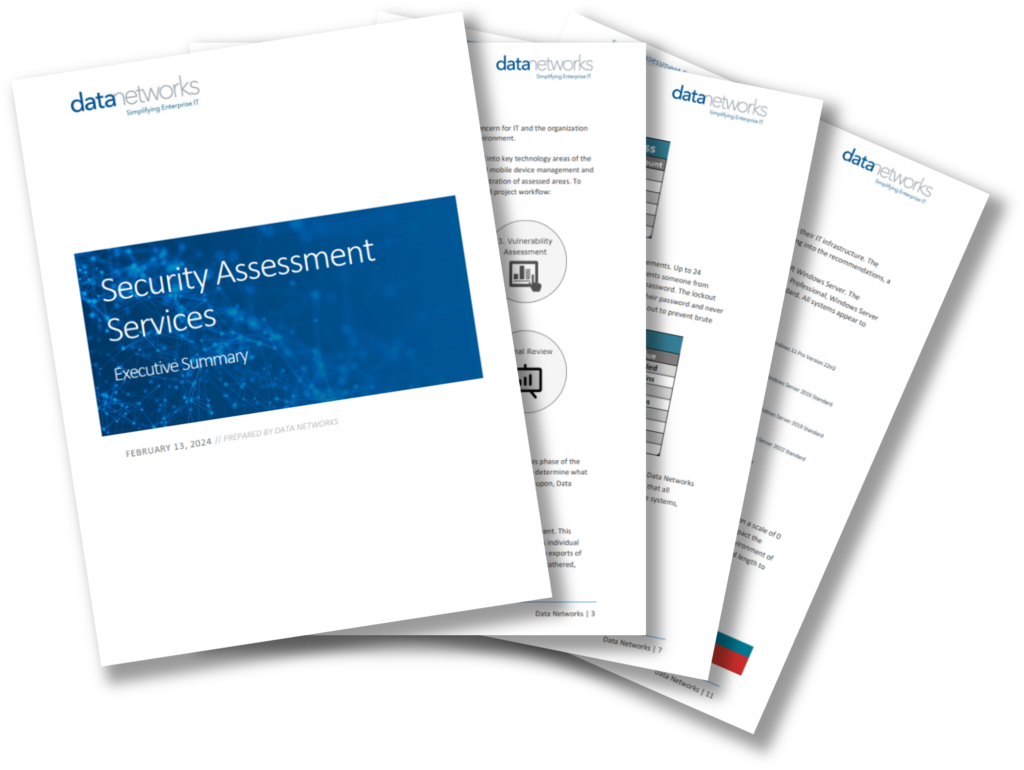
At the conclusion of the engagement, the organization received a detailed findings report, executive summary presentation, and prioritized remediation plan that provided clear direction for future security investments and operational improvements.
By combining vulnerability assessment services with strategic cybersecurity consulting, Data Networks delivered more than a point-in-time security review. The organization gained a practical roadmap for improving cyber resilience, reducing risk exposure, strengthening identity and endpoint security controls, and building a more mature cybersecurity program capable of adapting to future threats.
The result was a comprehensive understanding of the current security posture, a prioritized path toward remediation, and a stronger foundation for ongoing cybersecurity governance and risk management.
Tags: SLG, government, healthcare