
Recent Projects
Recent Project
VCSA Upgrade & VMware Infrastructure Modernization
VMware vCenter Server Appliance Upgrade, vSAN Express Storage Architecture, and Hyperconverged Infrastructure Deployment
The Challenge: Unsupported VMware Infrastructure and Rising Licensing Costs
This university facilities department needed to modernize its virtualization infrastructure to address growing performance demands, unsupported software versions, and increasing licensing costs. Existing VMware infrastructure components were no longer meeting security and compliance requirements, and legacy configurations were preventing upgrades to newer supported versions of VMware technologies.
The institution also faced operational challenges related to infrastructure sprawl and inefficient licensing utilization. Existing environments required excessive VMware socket licensing, included unsupported NSX-V components, and lacked the scalability needed to support expanding institutional workloads. At the same time, the organization needed to minimize downtime and maintain operational continuity while transitioning to a new virtualization platform.
To support future growth, improve resiliency, and simplify management, the university required a comprehensive VCSA upgrade and virtualization modernization initiative capable of consolidating workloads into a denser, more efficient hyperconverged infrastructure environment.
The Solution: VCSA Upgrade with VMware vSAN and Hyperconverged Infrastructure
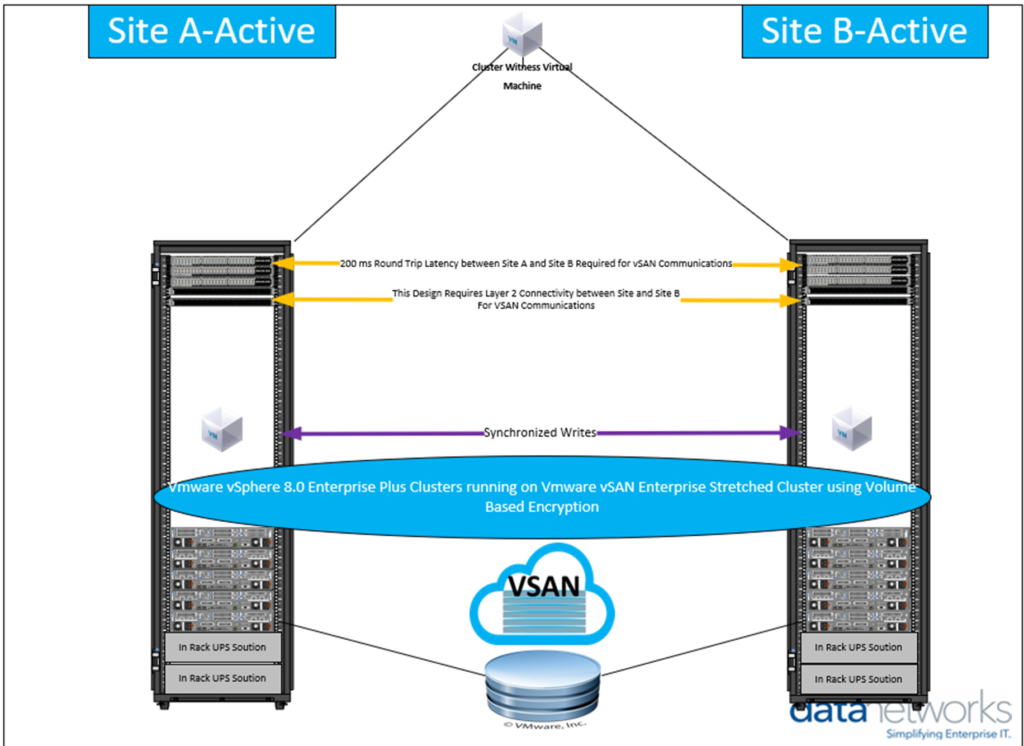
Data Networks delivered a large-scale VCSA upgrade and infrastructure modernization project centered around VMware vSphere Enterprise Plus 8.0 and VMware vSAN Express Storage Architecture (ESA).
The deployment included:
- Three (3) Dell PowerEdge R750 VMware vSAN Ready Nodes
- Two (2) Juniper 25Gbps switches
- VMware vCenter Server Appliance (VCSA) 8.0
- VMware vSAN Advanced licensing
- Dell OpenManage Enterprise integration
As part of the VCSA upgrade, Data Networks deployed and configured a new VMware vCenter Server Appliance 8.0 environment to provide centralized management, orchestration, and visibility across the upgraded virtualization infrastructure.
The engineering team also configured:
- VMware distributed virtual switches
- VLAN segmentation
- VMkernel networking
- vMotion traffic
- vSAN storage networking
- RAID 5 erasure coding using VMware vSAN ESA
To support high-performance virtualization and storage traffic, the new environment leveraged:
- 25GbE networking infrastructure
- 100Gbps inter-switch connectivity
- High-density all-flash storage architecture
- VMware vSAN Express Storage Architecture
Each node was configured with:
- 64 CPU cores
- 1 TiB of memory
- 16 x 6.4TB SSD drives per server
The deployment delivered:
- 1024TB of raw storage capacity
- Support for approximately 101 virtual machines
- High-performance all-flash storage resiliency
- Simplified hyperconverged infrastructure management
Data Networks also deployed Dell OpenManage Enterprise and integrated iDRAC9 Datacenter management into Microsoft Active Directory to improve monitoring, compliance management, and administrative visibility.
To ensure a smooth transition, Data Networks documented, validated, and tested migration procedures for workloads moving from the institution’s existing VMware vSphere 6.7 environment into the new infrastructure. The project also included validation of failover and failback processes to ensure operational continuity between sites.
The Outcome: Modernized VMware Management and Scalable Virtualization Infrastructure
Through this VCSA upgrade, the university successfully modernized its virtualization management platform while improving scalability, resiliency, and operational efficiency across its data center environment.
The deployment of VMware vCenter Server Appliance 8.0 and VMware vSAN ESA created a fully supported hyperconverged infrastructure platform capable of supporting long-term institutional growth and evolving workload requirements. By consolidating workloads into a denser infrastructure footprint, the institution improved compute and storage efficiency while simplifying day-to-day management operations.
The project also helped reduce operational and licensing burdens by:
- Reducing VMware socket licensing requirements
- Eliminating unsupported NSX-V infrastructure
- Streamlining virtualization feature utilization
- Avoiding costly legacy license renewals
With improved management visibility, validated migration procedures, and enhanced storage performance, the organization now benefits from a modern VMware environment built for scalability, resiliency, and simplified infrastructure administration.
Tags: Hi-Ed, higher education, datacenter